
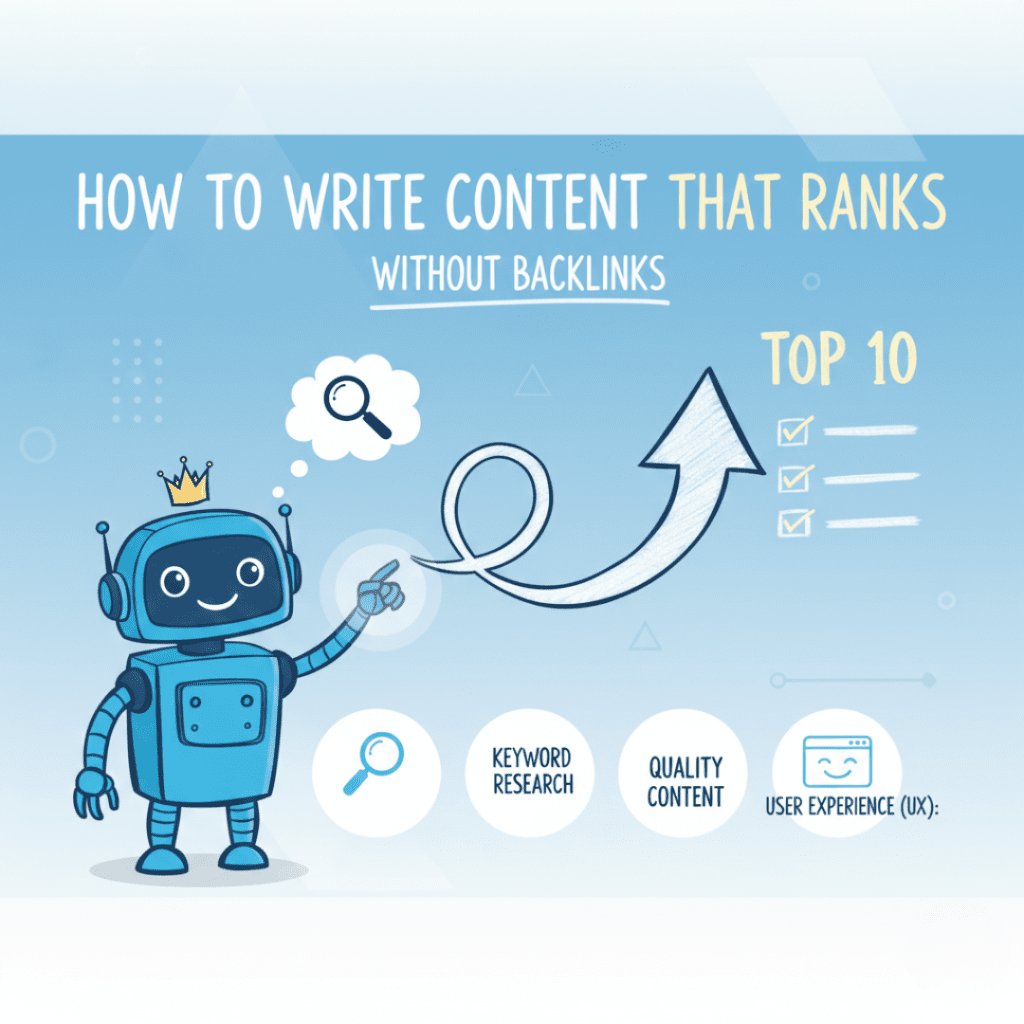
Can a page rank with few or even no backlinks? Yes, but only when it answers the search better than what’s already on page one. How to write Content that ranks without backlinks usually wins on match, not muscle. This works best for low-to-medium competition topics, local searches, niche problems, and long-tail queries where Google wants a clear, complete answer. The good news is you can use the same process every time, pick the right query, nail the intent, then publish the best page for that search.
Pick topics you can win without backlinks
If you try to outrank giant sites for broad keywords, great writing won’t save you. Winning without backlinks starts with choosing battles where Google is already showing smaller publishers, forums, or mixed results. Those are signs the algorithm isn’t locked into one “big brand” answer.
Use low competition, high intent keywords (and prove it in the SERP)
Before writing, scan page one like a home inspector. Forums, small blogs, outdated posts, thin listicles, weak titles, and missing steps all point to opportunity. Look for long-tail keywords, question keywords (“how do I…”), and “best for” queries (“best running shoes for wide feet flat arches”). Quick tip: compare the top 3 pages for depth and freshness, if they’re shallow or old, you can pass them.
One page should do one job. Decide what the query wants, a guide, list, template, definition, or comparison. Then write a one-sentence intent statement before you outline, like: “This page helps a first-time landlord write a simple lease addendum for pets.” That sentence keeps you from drifting into extra topics that dilute rankings.
Write the page that is the best answer on the internet
When backlinks aren’t doing the heavy lifting, your page has to feel like the obvious choice. Aim for completeness (covers the whole problem), clarity (simple steps, plain words), and structure (headings that match real questions). Add a small piece of value readers can’t get from five other posts.
Start by collecting real questions from People Also Ask, related searches, Reddit threads, and YouTube comments. Build sections around actions and decisions, not buzzwords. Include key definitions, step-by-step instructions, common mistakes, and one clear example. If a section doesn’t help the reader do something, cut it.
Add proof and originality that other pages do not have
Original bits build trust fast. Add one of these:
| Add-on | What it does |
|---|---|
| Mini case study | Shows real results and limits |
| Short checklist | Helps readers act right away |
| Simple template | Reduces guesswork |
Use E-E-A-T in plain terms: show you’ve done the thing, be specific, and cite reliable sources when facts matter.
Great content can still stall if it’s hard to scan or unclear.
On-page SEO that actually moves the needle
Use a title that matches intent, a short URL, and strong H2s that mirror sub-questions. Place the main answer in the first 100 words. Use your main keyword and close synonyms naturally. Keep paragraphs short, and add image alt text only when it helps understanding.
Link to the new post from stronger pages on your site using descriptive anchor text (not “click here”). Build a small topic cluster, one hub page plus a few supporting posts. Refresh the post every 3 to 6 months with new examples, updated screenshots, and a few extra FAQs.
Conclusion
To rank without link building, focus on three levers: pick winnable queries, write the best answer, and tighten clarity with on-page SEO plus internal links. Don’t chase everything, chase what page one already allows. Choose one keyword today, write a one-sentence intent statement, then improve the best competing page by one clear level.
Want to scale your reach like this? Contact Now : +91 8920214702
Let’s build your 1M-impression strategy together. Contact our team at digimarketing360.in today for a custom digital growth blueprint.
Follow us on Instagram @digimarketing360.in for daily tips and more…Get in touch
